The hidden performance problem
Knowing is not the same as being able to act.
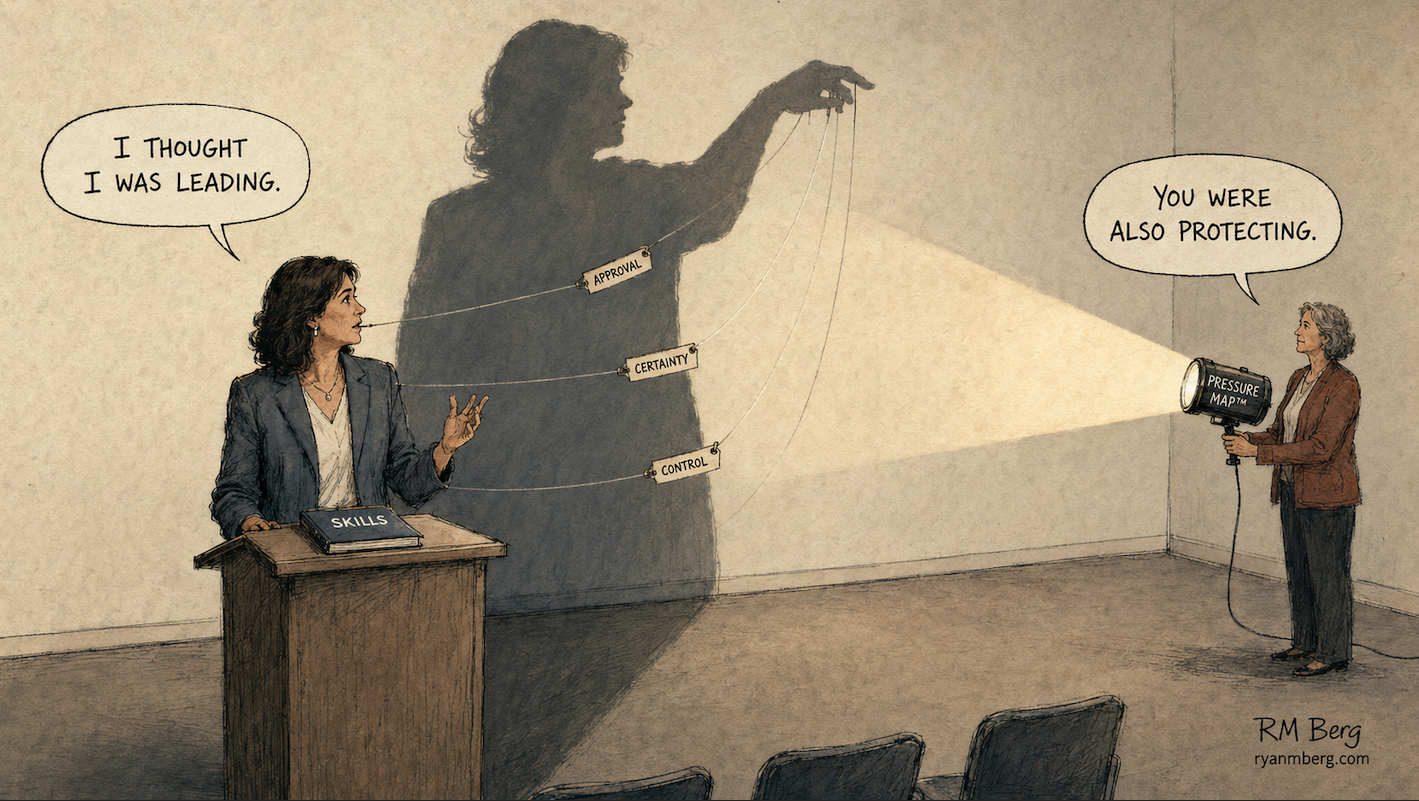
Your organization may not have a knowledge problem. It may have a judgment-under-pressure problem: the moment when clear policy, strong capability, and good intention collide with ambiguity, consequence, identity, status, or fear.
- The policy is clear.
- The skill has been taught.
- The tool is available.
- The intended behavior is understood.
- Wait for permission.
- Protect credibility.
- Avoid exposure or escalation.
- Repeat the pattern the system rewards.
Flagship corporate curricula
Built for the moments that decide performance.
Eight proprietary learning systems for stronger judgment, AI-enabled work, organizational change, managerial practice, candor, accountability, succession, and executive decision quality.
The learner experience, manager environment, workplace application, and evidence rhythm are designed together.
Executive judgment under consequence
Keep the mind wider than the pressure.
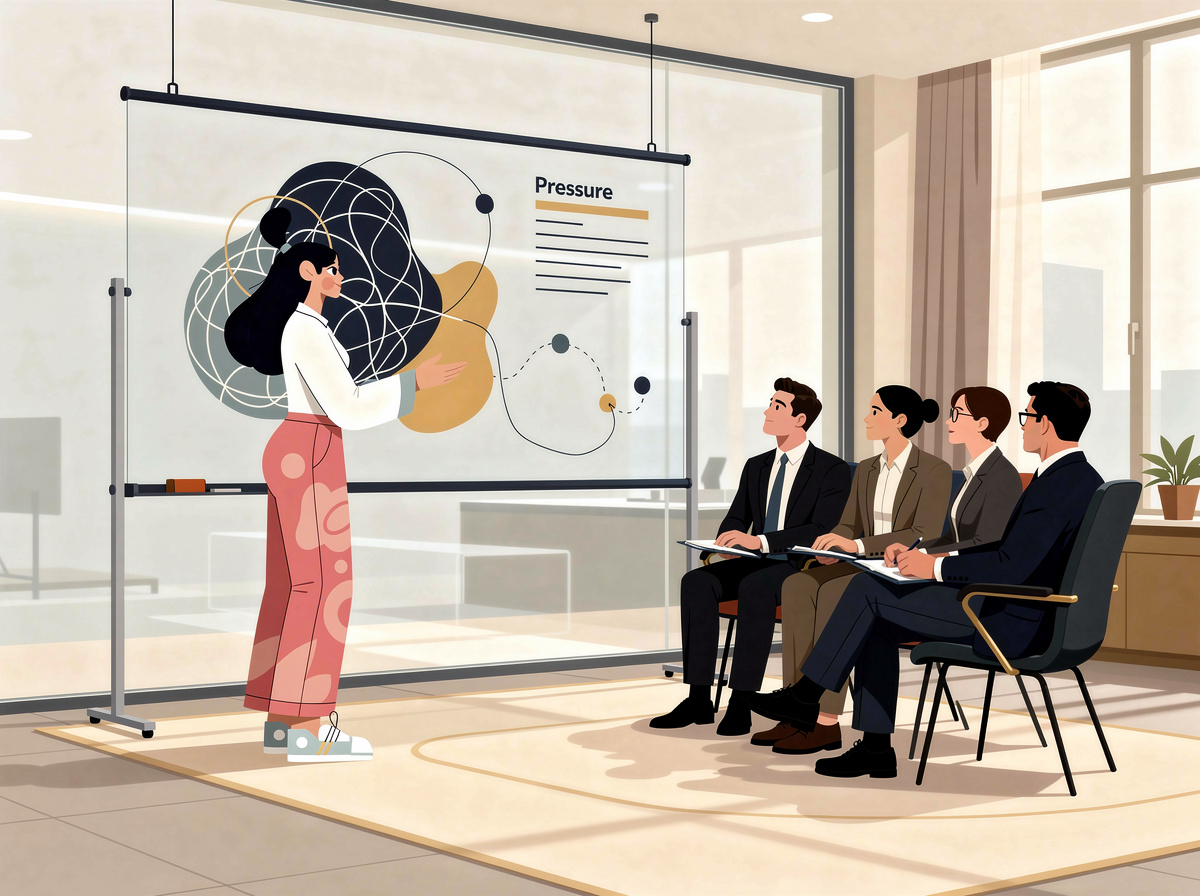
Leaders study how urgency, authority, belonging, credibility, and fear shape judgment. They practice identifying the pressure, locating the protected concern, testing the assumption, and choosing responsible action with more freedom.
AI-enabled work with human accountability
Put judgment where consequence lives.
Employees and managers redesign a real workflow, establish data boundaries, define verification gates, assign accountable human decisions, and prove value through a bounded pilot before wider adoption.
Adaptive capacity for real transformation
Build the capacity to move while the ground is moving.
Teams learn to read change friction as information, identify what the transition threatens, preserve what remains valuable, and run practical experiments that create movement without coercion or performative agreement.
Management as a consequence environment
Every response teaches people how to survive here.
Managers examine how their reactions to questions, mistakes, disagreement, uncertainty, and initiative shape the self employees bring to work. They practice coaching for evidence, ownership, autonomy, and responsible risk.
Early truth under consequence
Surface risk while it can still help.
Employees practice recognizing when information is becoming socially difficult to own, framing concern with evidence, choosing an escalation path, and responding to challenge in ways that preserve future candor.
Clear ownership with usable truth
Make accountability safe enough for honesty.
Leaders define ownership, standards, evidence, support, and consequences with precision. They practice correction conversations that protect dignity, expose reality, and make responsible action easier to sustain.
Leadership bench built through evidence
Develop next-level capacity before promotion.
Candidates translate a target role into its hardest demands, identify where current success may become a future constraint, complete stretch work, and build sponsor-visible evidence of readiness.
Collective judgment in live strategic work
Make the field visible before the decision hardens.
Executive teams work with a live decision, map the social and strategic forces shaping the room, surface information without a safe owner, test competing interpretations, and establish a reviewable decision record.
What TLS builds
From bench strength to deployment. One capability system.
Bench Development, curriculum architecture, WBT, live learning, facilitator enablement, learning operations, and AI adoption are built as one connected system. TLS can enter at leadership-pipeline diagnosis, discovery, course production, implementation, or enterprise rollout, then connect development to succession readiness, manager practice, customer education, workflow change, and measurable performance.
Leadership Bench Development
Build next-level leaders before vacancies, promotions, or disruption force emergency succession decisions. TLS combines role-readiness architecture, Pressure Map™ development, stretch work, manager calibration, and evidence reviews.
- Critical-role and succession maps
- Readiness profiles and development cohorts
- Stretch assignments and evidence reviews
- Manager calibration and internal mobility
Curriculum strategy and development
Build coherent learning systems from role and performance analysis through pathways, objectives, content sequencing, assessment, reinforcement, and measurement.
- Performance and audience analysis
- Curriculum maps and learning pathways
- Objectives, assessments, and rubrics
- Technical and workforce curriculum
Web-based training and courseware
SCORM and xAPI-ready modules with decision scenarios, branching, practice, assessment, video, accessibility, and executive-level visual polish.
- Custom coded and Articulate development
- Storyboards and interactive prototypes
- Course conversion and modernization
- Quality assurance and LMS-ready packages
ILT and vILT learning experiences
In-person and Zoom or Teams-ready programs built around real cases, facilitated practice, breakout work, reflection, coaching labs, and application to current business priorities.
- Facilitator and producer guides
- Participant workbooks and digital kits
- Manager coaching labs
- Cohort and workshop facilitation
Pressure Map™ train-the-trainer
Prepare internal facilitators, HR and L&D partners, and people managers to guide the method responsibly, coach from evidence, build employee autonomy, and sustain developmental practice inside real work.
- Facilitator preparation and rehearsal
- Practice, observation, and calibration
- Autonomy-coaching manager tools
- Ethical boundaries and debrief systems
Implementation, LMS, and program delivery
Turn finished content into a functioning learning operation through LMS configuration, course migration, customer education, launch planning, content governance, production management, and reporting.
- LMS setup, migration, and administration
- Customer education and onboarding
- Program and vendor management
- Measurement, reporting, and content QA
AI adoption and change enablement
Role-based learning and manager enablement that turn AI access into stronger work through use-case selection, workflow redesign, output verification, data boundaries, and clear human accountability.
- Role-based AI use cases
- Workflow and job redesign
- Verification and judgment routines
- Adoption strategy and manager reinforcement
Project-based by design. Start with a Bench Development diagnostic, a succession-readiness cohort, a curriculum architecture sprint, one WBT module, an ILT or vILT program, a Pressure Map™ train-the-trainer pilot, an LMS or customer-education implementation, or an AI-adoption sprint. TLS can diagnose the pipeline, build the learning, enable managers and facilitators, support deployment, and establish the evidence and measurement rhythm.
Scope a learning systemWorkplaces continuously develop people. The question is what they are developing them into.
TLS starts from a simple claim: behavior at work has structure. The visible pattern is only the surface. Underneath it is a logic shaped by pressure, protection, and the consequence environment of the organization itself.
Pressure reveals internal logic.
When the room gets hard, people do not simply apply what they know. They act from the logic organizing what feels necessary, safe, credible, or survivable in that moment.
Repeated behavior protects something.
Recurring patterns are usually preserving a protected good such as competence, belonging, control, credibility, identity, safety, or relational standing.
Consequences shape the self at work.
Every organization teaches adults which version of themselves can survive there through what it rewards, permits, ignores, punishes, and makes costly.
Development expands available action.
Learning becomes developmental when adults can examine the pattern, test the operating assumption safely, and widen the range of choices available under pressure.
“A workplace becomes developmental or deforming through the consequence patterns that teach adults what kind of self can survive there.”
This is the intellectual architecture underneath Pressure Map™ and the broader TLS system. It is the reason the work focuses on judgment, autonomy, protected concerns, managerial consequence patterns, and real-world experiments that convert insight into stronger action.
See the method Transformative Learning Solutions
The Human Judgment Readiness Index
AI is arriving faster than authority.
American businesses are adopting AI faster than they are redesigning work, training people, and clarifying who can make consequential decisions. TLS analyzed four current public data systems to locate the gap between technological adoption and the human infrastructure required for responsible use.
The finding in one sentenceAI is scaling faster than the authority, practice, and learning systems people need to exercise sound judgment under pressure.
U.S. Census Bureau BTOS · O*NET 30.3 · BLS OEWS · OSHA ITA
Faster Than Authority
Open the complete 35-page TLS research report.
Open the report ↗Original TLS research built from the latest available public data.

Schedule a Zoom
Pick a time that works. You’ll get an instant calendar invite and Zoom link.